Bonus: A bit of history behind the creation of Spider-Man
Have you ever felt even the slightest bit of curiosity about how Spider-Man was created, or at least what the story behind his creation was before his debut?
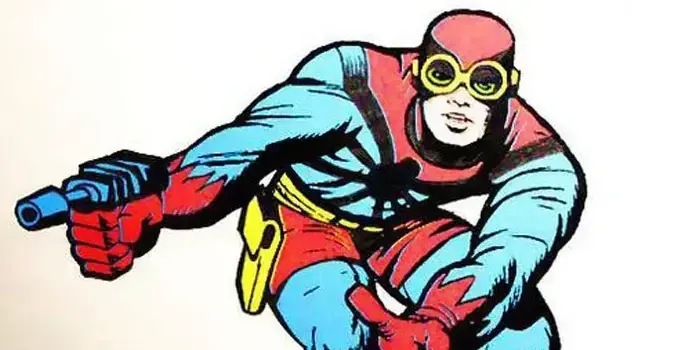
I have. But to tell this story, I must stop referring to him as Spider-Man and call him… The Fly? Exactly as you read it. That is what the first iteration of Spider-Man by Jack Kirby was called (for those who don’t know Kirby, I dare say that had he not existed, the MCU we know today—and certainly Marvel Comics—might not exist at all). But the idea wasn’t entirely Jack Kirby’s. In the 1950s, Joe Simon, the creator of Captain America, created “Spiderman” (without the hyphen). After changing the name to Silver Spider and being rejected, he recycled the ideas with Jack Kirby to create The Fly, who debuted in the late 50s.
Who is The Fly? The Fly is an orphan who, after obtaining a magic ring, transforms into an adult (like Shazam) and gains powers, such as 360-degree vision like a fly and the ability to stick to walls; similarly, he has a “buzz gun” that generates sonic blasts or fires tranquilizer darts.
When Stan Lee planned to create Spider-Man in the 60s, it was Kirby who proposed recycling Joe Simon’s original Spiderman idea, suggesting an orphan with an uncle who is a police captain (doesn’t that sound a bit like a certain Captain George Stacy?) and a scientist aunt (elements that eventually trickled down to Peter Parker and his father). The foundation was there. However, due to legal issues with Archie Comics (who had already used the character The Fly, who, as you’ll recall, was based on that first version of Spiderman), Steve Ditko insisted on abandoning Kirby’s proposal to create what we know today as Spider-Man. While I admire Stan Lee, it was Steve Ditko, not Stan Lee, who proposed the design, the origins, the web-shooters, and Peter’s personality, among other things… and if you look up Steve Ditko online, you’ll notice he based the physical appearance of 1960s Peter Parker on himself.
So, the history of Spider-Man begins long before the Silver Age: it traces back to the end of the Golden Age of comics. (An easy way to remember these eras is to know that during the Silver Age Marvel Comics became a cultural phenomenon; on the other hand, the Golden Age began with Superman’s debut in Action Comics #1 in 1938 and ended in 1956 when heroes became less relevant following the end of World War II; back then, Marvel was called Timely and later Atlas Comics).